


In focus: The Chiquitita Story
Since its original release in 1979, Chiquitita has come to be recognised as one of ABBA’s biggest-ever hits. But if fate had willed otherwise, Chiquitita might today have been known as – Rosalita.
If It Wasn’t For Summer Night City
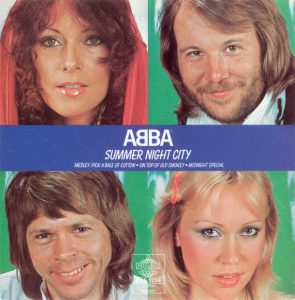 It was early December 1978 and sessions for ABBA’s new album were if not exactly disastrous, at least not going as smoothly as could be expected. Sessions for the album that would eventually become Voulez-Vous had begun in March, picked up speed in April and then moved to the group’s brand new Polar Music Studios in June. So far, all the hard work had yielded one single release in September: ‘Summer Night City’. But the group wasn’t entirely satisfied with the outcome of that single, and although it certainly wasn’t a flop, it was a little less successful in international terms than ABBA had come to expect from their single releases (read more in 25 Years Of Summer Night City in the Articles archive). And now, after a period of almost nine months – a time frame that was twice as long as the recording period for the entire Waterloo album five years earlier – they didn’t even have half an album’s worth of tracks that they were truly satisfied with.
 However, they knew that they wanted to issue a new single fairly soon. Indeed, there was even a specific goal for their next release. On January 9, 1979, a very special benefit concert was scheduled to be held in the United Nations General Assembly in New York City. The purpose of the show was to raise money for UNICEF world hunger programs, but also to mark the beginning of the International Year Of The Child. There was also the idea that each of the participating artists should contribute a special song, donating the royalties for that song to UNICEF. The entire project had been dreamed up by The Bee Gees, their manager Robert Stigwood and television personality David Frost. ABBA were due to participate, and the other artists were The Bee Gees, Andy Gibb, Olivia Newton-John, John Denver, Donna Summer, Rita Coolidge, Kris Kristofferson, Rod Stewart and Earth Wind and Fire. The Bee Gees, for example, released their contribution, ‘Too Much Heaven’, as a single in November – achieving a worldwide smash hit – and ABBA planned to release their song in January. In early December, it looked as if the new single would be ‘If It Wasn’t For The Nights’, an up-tempo, dance-friendly number and one of the few recordings from the past months that they were happy with.
The tale of Rosalita
 Still, work on the new album had to continue, and on December 4, Björn, Benny and their trusted musicians gathered in the studio for the recording of a brand new song. At the time, it was adorned with the somewhat ludicrous working title ‘Kålsupare’ (loosely translated as “birds of a feather”), which had absolutely nothing to do with the actual tune. The backing track perfected, Björn came up with a concept for the lyrics wherein the protagonist addresses herself to a former lover who now prefers another woman. The title of this new tune became ‘In The Arms Of Rosalita’. Agnetha and Frida recorded their vocals, taking turns to sing the verses so that they both acted the part of the scorned woman.
But although this recording was compelling enough, the group felt that something wasn’t quite right with it. The backing was slower and heavier than they wanted, and the recording just didn’t realise the potential inherent in the tune. Further work on the track was halted for the time being, and while ABBA contemplated matters, on December 6 they went to London, England, for some television work. Most notably they appeared on The Mike Yarwood Christmas Show (broadcast on Christmas Day, December 25), performing what they then thought would be their next single: ‘If It Wasn’t For The Nights’.
Two wise guys
 Upon returning to Sweden, Björn and Benny again asked the session musicians to come to the studio for a reworking of the backing track of ‘In The Arms Of Rosalita’. The date was December 13, 1978, and the contributing players were some of their most trusted collaborators: Ola Brunkert on drums, Rutger Gunnarsson on bass and Lasse Wellander on guitar. This second attempt at a backing track was adorned with the working title ‘Kålsupare II’, subsequently changed to ‘Three Wise Guys’. Working out the new arrangement, many of the features of the first version were retained. For example, the acoustic guitar intro by Lasse Wellander had been there from the beginning, although it was expanded upon a little for the new version. But the song writers also felt that they wanted to emphasise the Latin American feel of the tune, and on the session tapes they can be heard discussing ‘El Condor Pasa’ (as made famous by Simon and Garfunkel) as a suitable point of reference.
 Another crucial decision was also made for the restructuring of the song: a bridge in the middle of the composition – featuring vocals from the group in its ‘In The Arms Of Rosalita’ incarnation – was moved to the end of the song instead, and relieved from its vocals. In fact, only the chord structure for this section remained, and a completely new instrumental melody played on piano was invented by Benny. The new backing track was certainly “lighter” in feel than the first attempt, and did indeed bear some resemblance to ‘El Condor Pasa’. For the vocal overdubs by Agnetha and Frida, Björn wrote new lyrics, at first entitled ‘Chiquitita Angelina’ and then reworked yet again to become simply ‘Chiquitita’. With Agnetha singing the first verse alone, joined by Frida for the remainder of the song, the lyrics were now transformed into a message of comfort and encouragement, wherein the singers try to instil some hope of better days to come into a heartbroken friend. A few lines here and there from ‘In The Arms Of Rosalita’ were actually retained for the new song, albeit in slightly reworked form, such as “enchained by your own sorrow” and “there is no hope for tomorrow”.
Nations united in praise for Chiquitita
 With the song completed, finalised and mixed, ABBA themselves and everyone around them realised that they had a new strong contender for single release. Thus it was decided to let ‘If It Wasn’t For The Nights’ remain an album track, and to make ‘Chiquitita’ the new single and, most crucially, the song the group donated to UNICEF. Perhaps it was also felt that this ballad, with its hopeful ambience, was more suitable for a charity cause than an up-tempo disco track such as ‘If It Wasn’t For The Night’. In any event, ‘Chiquitita’ was first unveiled to the world at the UNICEF concert on January 9, 1979. The show was then televised in the United States on January 10, with broadcasts following all over the world. Then, on January 16, the ‘Chiquitita’ single was released, immediately becoming a big hit and performing much more convincingly in the charts than ‘Summer Night City’ had done, reaching number one in at least 10 countries and the Top Ten in plenty more.
Unusually for ABBA, but perhaps an inevitable consequence of the fact that the song was released just a month after having been completed in the studio, there was no Lasse Hallström-directed promo clip for the song. Instead, the group dashed off a simple performance for the BBC in February, while they were on location in Switzerland for a television special. This performance, filmed outdoors in front of a huge snowman, was subsequently used as the official clip for the song and can be viewed on the DVD compilations The Essential Collection and ABBA Gold.
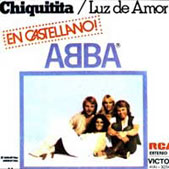
As a coda to the ‘Chiquitita’ success, the song was also selected as the tune that would help ABBA achieve a convincing breakthrough in South America, where they hadn’t enjoyed much success up to that point. Buddy McCluskey, an employee at RCA Records in Argentina, collaborated with his wife, Mary, on the Spanish lyrics for ’Chiquitita’, which was certainly the ultimate song for such an endeavour, seeing as it was Spanish-flavoured in both arrangement and title. The Spanish version was released as a single in Argentina in April 1979, hitting number one on the charts. Within a few months the Spanish ’Chiquitita’ had sold half a million copies in Argentina alone, and was said to be the biggest hit in South America in 25 years. No doubt, the Spanish-language success helped ‘Chiquitita’ become one of ABBA’s most popular songs.


